
The Question That Keeps Parents Up at Night
Your autistic child walks out of school beaming. The teacher says they had a great day, participated in class, played nicely at recess. You think, “Finally, maybe we're past this rough patch.” Then you get home.
The moment the front door closes, everything changes. Your child falls apart. A meltdown over homework. Sensory overload at dinner. Aggressive outbursts. Emotional floods you can't explain or contain. You wonder, “Why is the teacher seeing a completely different child?” You worry you're doing something fundamentally wrong at home.
You're not. What you're witnessing is one of the most misunderstood realities of autism: the cost of masking.
The School Mask Is Real and It's Neurologically Exhausting
Your autistic child isn't behaving differently at school because they want to be good for the teacher. They're not having a good day and then choosing to melt down at home.
What's happening is this: Your child is using every ounce of their neurological resources to hold it together in a system that doesn't naturally match how their brain works. They're masking, and masking is work. Hard, invisible, relentless work.
Imagine you're left-handed but everything in your school is designed for right-handed people. Your desk, the writing surface, the social norms, the sensory environment, all of it. You force yourself to write with your right hand. You sit at an angle. You ignore the pen pressure that makes your hand ache. You manage your frustration when the teacher corrects your grip. You hold it together.
By the end of the day, your hand is sore and your head aches. But you made it through. You appeared fine.
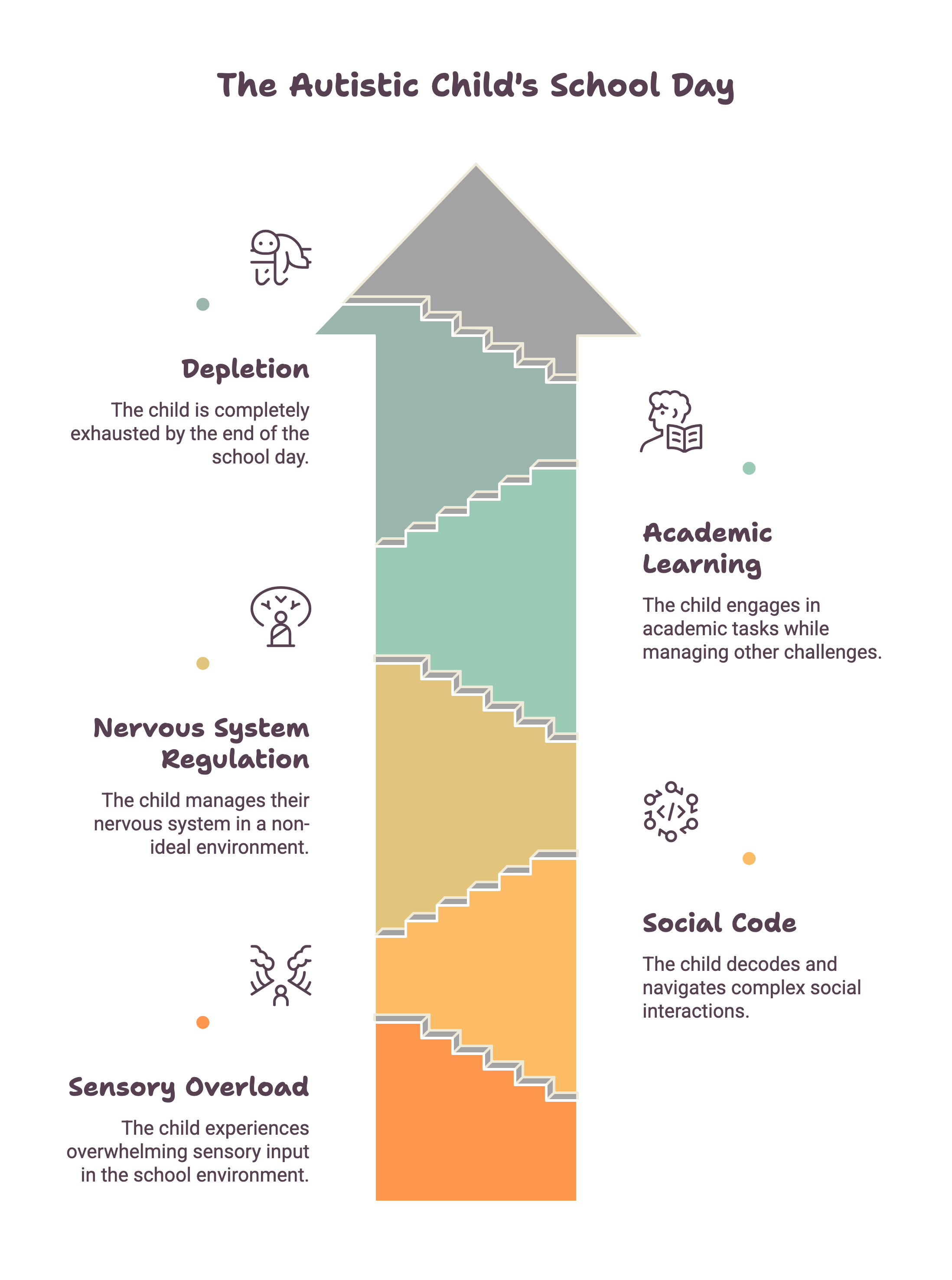
That's what your autistic child is doing at school. They manage sensory overwhelm, process an unwritten social code they decode moment by moment, regulate their nervous system in an environment not built for how they perceive the world, and do all this while also learning academics.
And they succeed at it. Which is remarkable. Which is also why they're completely depleted by the time they get home.
The Depletion Is Real
Think of your child's nervous system like a battery. During the school day, they run at maximum power, using every compensatory strategy available. By the time they walk through your front door, that battery is at 1%.
When your phone battery hits 1%, it shuts down. Non-essential functions stop working. It gets hot. It becomes unpredictable.
Your child's nervous system works the same way. When depleted, they can't access the same regulation skills they used all day. They can't think through their reactions. They can't mask anymore. The survival mechanisms that kept them "fine" at school are now working against them.
And here's what matters: this is a sign of how well they're doing at school, not how badly they're doing at home.
Home Meltdowns Are a Sign of Trust
Your child is falling apart at home, with you. Not in public. Not at school.
This is neurology meeting wisdom. Your child has learned that home is the one place where they don't have to mask. That you won't reject them for not holding it together. That you're safe enough to be unregulated around.
That's not a sign of bad behavior. That's a sign of attachment. Of trust. Of knowing they're safe enough to stop performing.
What This Means
If your child is holding it together at school and falling apart at home, they're succeeding at adaptation and trusting you with their whole selves.
You're not failing. Your child is working twice as hard as their peers, and succeeding.
Part 2 coming soon: How to support a masking child, rebuild their regulatory capacity at home, and help them develop sustainable coping strategies.
