
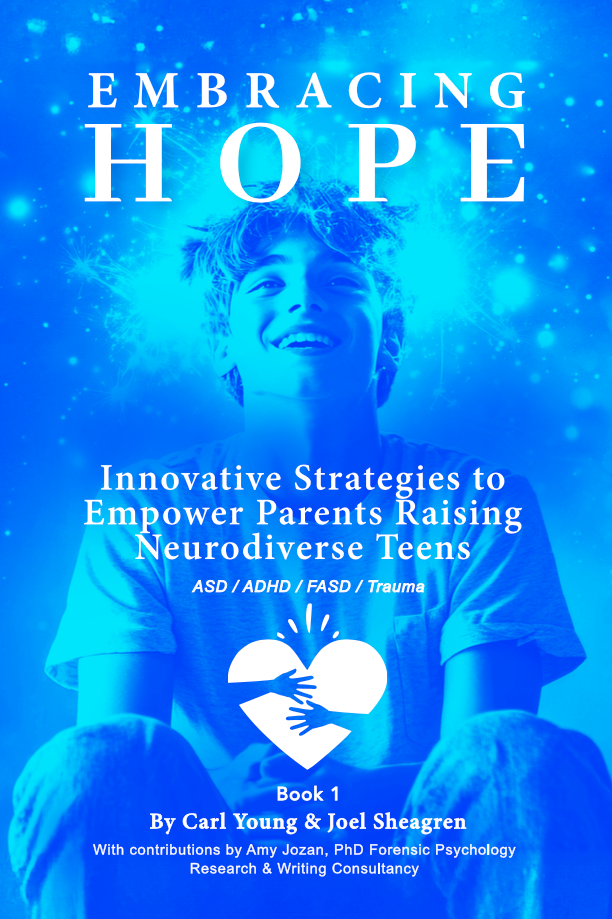
Embracing Hope
Book Introduction
Everything on this page is free, our gift to you, supplemental resources going deeper than the book, with extended guides, brain science, practical tools, and parent scripts organized chapter by chapter.
Introduction: A Different Kind of Parent Guide
Picture this: two dads, a whole lot of coffee, and countless "interesting" parenting moments that would make reality TV look boring. We're not just authors writing another parenting book — we're fathers who live this journey every day, celebrating the beautiful chaos and unexpected joys of raising children with FASD, ASD, ADHD, and trauma-related challenges.
We've translated cutting-edge neuroscience into "kitchen table wisdom." Every strategy we share has been tested in real homes (including ours!), refined through practical application, adapted for our children's various neurodevelopmental profiles, and validated by leading researchers worldwide through evidence-based research.
Real Homes
Eight years ago, we were just like you — searching for answers, feeling overwhelmed, and wondering if we were doing the right things.
Real Research
Everything we share comes from years of intensive research, collaboration with leading experts, and — most importantly — learning from our children.
Real Strategies
These strategies work in real homes with real families — no sterile clinic settings or theoretical frameworks that fall apart at the kitchen table.
Why This Book Is Different — Three Pioneering Firsts
What makes this guide revolutionary isn't just that it breaks new ground — it's how these elements work together in one book.
First parent guide to explicitly recognize FASD as part of the neurodiversity spectrum — alongside ASD, ADHD, and trauma in one caregiver book.
First resource bridging the gap between professional expertise and lived experience — authored by two fathers who have walked this road.
First comprehensive approach treating these four profiles not as separate challenges but as interconnected, overlapping aspects of neurodiversity's uniqueness.
Your Child's Emotional World
Our neurodiverse children don't just feel emotions — they experience them in HD, 4K, and sometimes in IMAX®! While other children might get frustrated, our kids might feel like they're starring in their very own action movie. That's not a problem to be solved — it's an intensity to be channeled. Throughout this book, we show you how to turn these intense emotions into opportunities for growth and connection.
A Note About Privacy
While the stories you'll read are real (or based on real stories), we leverage fictional characters to protect the privacy of our children and families. After all, our kids are already superheroes — they don't need their secret identities revealed.
Whether you're a veteran parent, a grandparent stepping into a primary caregiver role, a foster or adoptive parent, or a professional — a teacher, social worker, therapist, or group home caregiver — you've found your tribe. Together, we're not just raising children — we're raising world-changers.
Explore All 20 Chapters

How to Read This Book
A guide to navigating Embracing Hope's unique structure so you get the most from every chapter — wherever your family is right now.
- How each chapter is structured and why
- How to find what your family needs most
- The Core Conversations framework explained
- A personal note from Carl & Joel
Understanding Your Child's Brain
The brain orchestrates every behavior, thought, and emotion. This chapter gives you two essential frameworks — brain regions and brain domains — for understanding why your child does what they do.
- Brain regions vs. brain domains explained
- The 10 Brain Domains reference guide
- Neuroplasticity — the science of hope
- How to use brain science with your child's team
Understanding Neurodiversity
What does neurodiversity actually mean for your family? This chapter traces the history of the term, what it encompasses, and why embracing difference — rather than fixing it — changes everything.
- The history and meaning of neurodiversity
- Why FASD and trauma belong in the conversation
- The garden metaphor for how brains grow differently
- A shift in perspective that changes your parenting
Why These Four Profiles
Deep dives into Autism (ASD), ADHD, FASD, and Trauma — the four profiles at the heart of this guide — with strengths, myths, overlapping symptoms, and full support strategies.
- ASD: DSM-5 levels, masking, sensory, identity
- ADHD: Executive function, school tips, girls & ADHD
- FASD: The hidden disability, memory, adaptive skills
- Trauma: The five responses, healing pathways, faith spaces

Intelligence & Adaptive Skills
Why IQ doesn't tell the whole story — and how to build the bridge between what a child understands and what they can consistently do in daily life.
- IQ vs. adaptive functioning explained clearly
- Three pathways: Conceptual, Practical, Social
- The Independence Ladder framework
- Language shifts and weekly practice plan
Insights to Self-Esteem
How self-worth develops in neurodiverse children, what low self-esteem really looks like, and practical tools for building a confident inner voice.
- Extended symptom guide across 10 categories
- Brain regions that shape self-perception
- Metacognition: Notice → Name → Choose
- Thinking traps and parent reframing scripts
Dysmaturity: Developmental Versus Chronological
Why many neurodiverse teens function younger than their chronological age — and what that means for your expectations, your communication, and your home.
- Developmental vs. chronological age explained
- Why it looks like laziness — and why it isn't
- Practical expectations adjustment guide
- Communication strategies that actually meet them where they are
Social Cues: The Hidden Language
The unwritten social rules most children absorb naturally — and practical tools to make the invisible visible for neurodiverse learners.
- Why social cues are a foreign language for many teens
- Reading faces, tone, and body language
- The Expression Game intervention
- Parent coaching scripts for real-world situations
Transitions: Trouble with Change
Why changes — big and small — can be so disruptive, and proven strategies to build predictable bridges between activities.
- Why transitions feel like a neurological earthquake
- Preparing in advance with mental GPS tools
- Transition routines that reduce meltdowns
- Scripts for school, home, and community transitions
Perseveration: Danger Zone
The stuck-in-a-loop thinking pattern — understanding why the brain gets locked on an idea and how to gently shift gears without escalating conflict.
- What perseveration is and why the brain does it
- The difference between stubbornness and brain wiring
- Redirection techniques that work with — not against — the brain
- Visual tools to interrupt the loop safely
Confabulation: Is it True?
Why neurodiverse children fill in memory gaps with inaccurate information — and why it isn't lying, manipulation, or defiance.
- Confabulation vs. deliberate lying — a clear comparison
- The CONNECT Method for daily practice
- Memory support strategies for the home
- How to respond with curiosity instead of confrontation
Abstract Thinking: Who's Adam?
Why metaphors, sarcasm, and figurative language can genuinely confuse neurodiverse learners — and tools for making abstract ideas concrete.
- What abstract thinking is and why it's hard
- Rigid thinking and difficulty with perspective-taking
- 'What If' conversations to build flexible thinking
- Outdoor and map-based activities for abstract reasoning
Cause & Effect: Does What I Do Matter?
The often-broken connection between actions and consequences — and why it doesn't compute for neurodiverse brains under stress.
- Why cause-and-effect reasoning breaks down
- Real-world examples parents can use today
- The Mindshifter Board Game intervention
- Visual consequence mapping for home use
Impulse Control: Resisting the Urge
What's happening when a child acts before thinking — and evidence-based strategies to help them pause and choose before reacting.
- The neuroscience of impulse and the role of the PFC
- Halt, Observe, Plan (H.O.P.) — the core strategy
- Parent scripts for in-the-moment support
- Building the pause reflex over time
Self-Regulation: Controlling Internal Pressures
The skill behind all other skills — building internal regulation capacity over time and with consistent, compassionate support.
- Why neurodiverse teens are easily overwhelmed
- The regulation toolkit: breathing, movement, environment
- Building neuropathways through safe repetition
- Co-regulation: what parents can do in the moment
Cloak of Competency: Mastery of Disguise
When children mask their struggles so effectively that adults — and even the children themselves — miss how much support is actually needed.
- What masking is and why neurodiverse children do it
- The long-term cost of sustained masking
- Signs your child may be cloaking their challenges
- Creating safety for your child to be seen
Processing Speed: Slow Down!
Why some brains need more time to think and respond — and why that has nothing to do with intelligence or effort.
- What processing speed is and how it affects daily life
- Why pressure makes it worse
- Environmental and communication adjustments that help
- Advocating for extra time at school and beyond
Sensory Overload: A Stimulus-Rich World
How sensory input affects behavior, regulation, and learning — and practical tools to reduce overload at home and in the community.
- The eight sensory systems and how they interact
- Why sensory overload triggers behavior — not defiance
- Sensory-friendly environment checklist
- Tools to help your child self-identify their triggers
Sleep, Nutrition & Exercise
The three biological foundations of brain function — and why they matter even more for neurodiverse children.
- How sleep affects regulation, memory, and mood
- Nutritional approaches that support neurodiverse brains
- Why movement is non-negotiable for brain health
- Practical routines to strengthen all three foundations
Cultivating Respect
Putting it all together — building homes, schools, churches, and communities where neurodiverse individuals are genuinely seen, honored, and empowered to contribute their unique gifts.
- Building a culture of dignity at home and school
- Faith communities and neurodiversity
- Moving from accommodation to true embrace
- A final word from Carl & Joel
Purchase Now
These supplemental resources complement Embracing Hope — the complete 488-page parent guide packed with research, strategies, and real hope. Get your copy today.
View Books →Online Courses
Structured, guided learning with video, tools, and direct access to Carl & Joel's expertise — built around the Core Conversations in this book.
Explore Courses →"Every child deserves to feel that they are not a problem to be solved — but a person to be supported."— Carl & Joel, Embracing Hope