What is Home and Community Based Services (HCBS)
What is HCBS? Home- and community-based services (HCBS) are Medicaid-funded supports — such as personal care, respite, supported employment, and in-home nursing — that allow people with disabilities and older adults to live in their own homes and communities instead of institutions.
What is the Olmstead Decision?
What is the Olmstead integration principle? In 1999, the Supreme Court ruled in Olmstead v. L.C. that unnecessary institutionalization of people with disabilities can be a form of discrimination under the ADA, and that states must provide services in the most integrated setting appropriate when reasonable to do so.
“The federal government has not issued an order to institutionalize people with disabilities. The concern is that weakening community-living protections, while community-based services remain fragile, could leave some people with no realistic alternative to institutional care.”
The Americans with Disabilities Act has not been repealed. Section 504 has not been repealed. The Supreme Court's Olmstead decision remains in effect. An Office of Legal Counsel opinion states the executive branch's current legal position — it does not carry the same binding authority as a Supreme Court ruling, and it does not by itself change what the law requires.
How the Loss of Community Support Can Lead to Institutional Care
This is not something the policy brief presents as certain to happen. It is a risk the brief evaluates, based on what tends to occur when community infrastructure weakens. Here is the general pattern:
Community support is reduced or becomes unavailable
Caregivers or providers are no longer able to sustain services
Housing or health stability begins to break down
A crisis point is reached
A hospital, nursing facility, psychiatric unit, congregate facility, shelter, or correctional setting becomes the only place available
This sequence is a foreseeable risk, not a prediction. Whether it occurs - and how often - depends on decisions still to come at the federal, state, and local level, including funding, workforce investment, and how agencies choose to respond.
This is a Developing Policy Issue
-
What the June 18, 2026 OLC opinion says, and what it does not say.
-
How this differs from the federal government's longstanding interpretation of Olmstead
-
North Dakota's existing HCBS system and how it is structured.
-
Populations most likely to be affected by a narrower federal position
-
Institutional and community-service capacity across the state
-
Workforce shortages and the limits of family-caregiver capacity
-
North Dakota's history with institutionalization and federal oversight
-
Questions raised for congressional consideration
Embracing Neurodiversity will update this page as significant federal guidance, court decisions, congressional action, or North Dakota policy developments materially affect this analysis. Earlier editions of the brief will remain available on this page, clearly labeled, so that researchers, advocates, and policymakers can track how the analysis has evolved.
Community Living Is More Than a Service Setting
Living at home, maintaining family relationships, participating in community life, and receiving support without unnecessary confinement are not incidental benefits. They are matters of liberty, dignity, and meaningful choice for every person with a disability.
Protecting the Right to Live in the Community
Federal disability policy is changing. Recent actions by the U.S. Department of Justice have raised new questions about how the Americans with Disabilities Act, Section 504, and the Olmstead decision will be enforced going forward. Embracing Neurodiversity is tracking these developments and their potential impact on the home- and community-based services North Dakota families rely on.
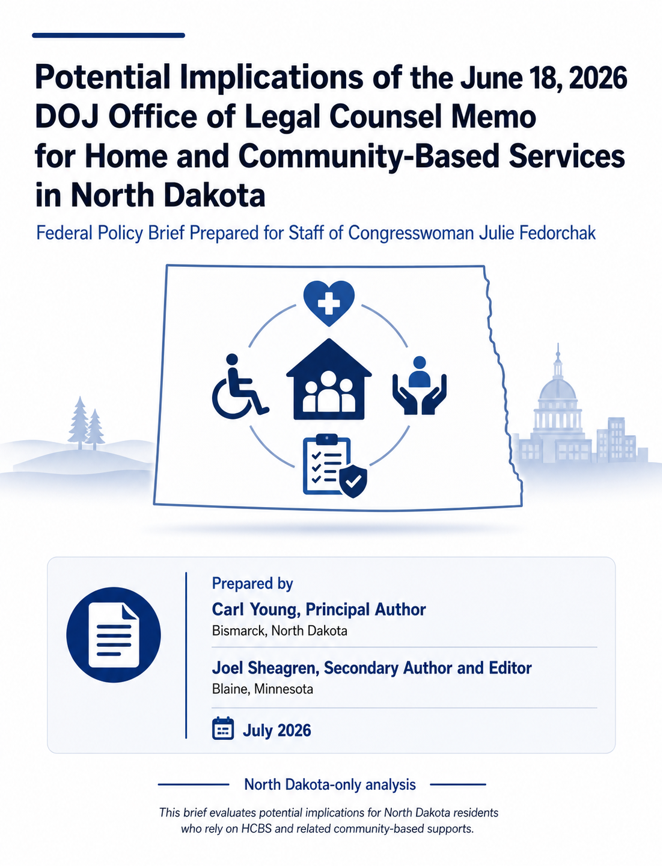
The Potential Impact of the June 18, 2026, Department of Justice Office of Legal Counsel Memorandum on North Dakota's Home- and Community-Based Services System
Metadata:
Prepared for: Office of Congresswoman Julie Fedorchak
Principal author: Carl Young, Bismarck, North Dakota
Secondary Author/Editor: Joel Sheagren, Blaine, Minnesota
Publisher: Embracing Neurodiversity, LLC
Document ID: ND-HCBS-PB-2026-07-20
Version: 1,1
Revision date: July 20, 2026
Format: PDF
Length: 131 pages
Accessibility: This publication is being reviewed for digital accessibility. A Microsoft Word version is available upon request. Please contact us if you encounter an accessibility barrier or need the publication in another format.
Why This Brief Matters
On June 18, 2026, the Department of Justice's Office of Legal Counsel issued an opinion questioning the legal foundation of the federal integration mandate connected to the Americans with Disabilities Act, Section 504 of the Rehabilitation Act, and the Supreme Court's Olmstead v. L.C. decision. On July 20, 2026, the Department published a notice in the Federal Register stating it would no longer rely on its longstanding Olmstead guidance when enforcing Title II of the ADA, and that it would reconsider whether that guidance still reflects the Department's current interpretation of the law.
These are significant developments in federal disability policy. The Olmstead integration principle has, for more than two decades, supported the expectation that people with disabilities have the right to receive services in the most integrated setting appropriate to their needs, rather than being placed in institutions when community-based care is possible.
For North Dakota, this matters more than in many states. North Dakota is largely rural, with long distances between service providers and the families who need them. The state already faces a shortage of direct-care workers, and many families depend heavily on unpaid caregiving from parents, siblings, and extended family to fill the gaps. When federal protections for community-based living are uncertain, states with the thinnest service infrastructure and the most caregiver reliance have the least room to absorb further strain.
Who Could Be Affected