
Executive Function at Home: How to Help Kids Who Struggle With Time, Tasks, and Transitions
Executive function is the brain's management system. When it's still developing, ordinary days at home can turn into a daily fight with the clock.
"Five more minutes" turns into forty. You asked your child to clean their room, and an hour later they're sitting in the middle of the floor holding one Lego, completely stuck. It's time to leave for school, the shoes aren't on, the backpack is missing, and the moment you say "Let's go," everything falls apart.
It's easy to call that laziness or defiance. Most of the time, it's neither.
It's not "won't." It's "can't yet."
What Executive Function Really Is
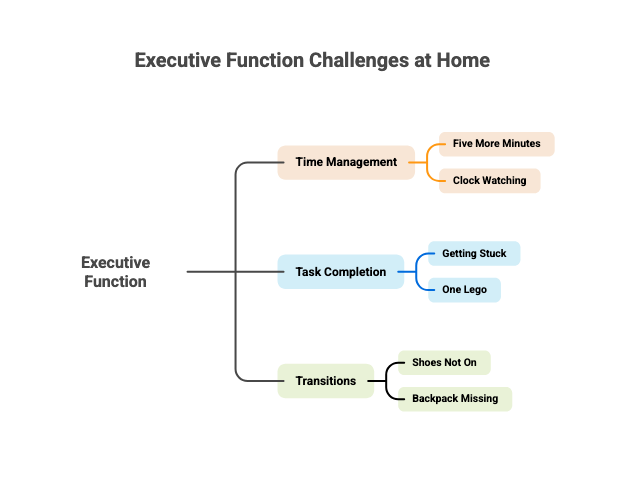
Harvard's Center on the Developing Child compares executive function to an air traffic control system in the brain. It helps us hold information in mind, focus, filter out distractions and switch gears. It rests on three core skills: working memory, mental flexibility and self-control.
These skills take a long time to grow. Harvard notes they keep maturing "through the teen years and into early adulthood." Many of our neurodivergent kids develop them on a different timeline, and sometimes along a different path.
ADHD often shows up as time blindness. For many kids with ADHD there are really only two times: now and not now. The 3:00 appointment doesn't feel real until it's 2:58.
FASD affects the brain's ability to plan, organize and connect steps. A large research review found significant executive function difficulties in children with FASD. Your child may know every step of the morning routine on Sunday and completely lose track of it on Monday.
Autism often makes shifting gears hard. Mental flexibility is one of the executive function areas researchers have linked to autism. A transition isn't just a change of activity. It can feel like the ground moving.
Trauma keeps the brain on alert for danger. When a nervous system is on high alert, there's little fuel left for planning. A sudden change can feel like a threat.
That's the shift from blame to brain.
Why Can't My Child Just Get Started?
If you're typing that question at 1 a.m., here's the honest answer: getting started is an executive function skill in itself.
A task like "clean your room" asks the brain to break a big job into steps, pick the first one and ignore everything else. When that system is overloaded, the child freezes. What looks like stalling is often a brain that can't find the on-ramp.
That freeze isn't a character flaw, and more pressure won't build the missing skill. (We wrote more about that in Why Consequences Don't Always Work for Neurodivergent Kids.)
Executive Function Strategies for Kids at Home
Make time visible. Use analog clocks, visual timers and sand timers. "We leave when the red is gone" works better than "ten minutes." For a child with time blindness, time they can see is time that feels real.
Shrink the task. "Clean your room" becomes "Put the books on the shelf," and then the next step. A short checklist, with pictures if that helps, lets your child see progress. Small wins build momentum.
Warn before you switch. Count down to transitions: "Ten minutes, then five, then shoes." Use first-then language: "First shoes, then the car song." When the schedule is going to change, tell them early.
Let routines do the remembering. Do things in the same order, in the same place, every day. Set up a "launch pad" by the door for shoes and the backpack, and pack the night before. Routines take the load off working memory and turn it into habit.
Lend your brain, then step back slowly. Sit nearby while they work, do the first step together and check in gently. That's support for skills still being built, not enabling. As their skills grow, pull back a little at a time.
A Good Work, Still in Progress
Some mornings will still unravel. That's okay. Progress may look like one fewer late start this week, or one transition with a pause where there used to be a meltdown. That counts.
All of us are unique and valuable. Our kids are still growing, and so are we. Executive function doesn't grow in one big lesson. It grows through hundreds of small, patient, repeated moments.
Your child isn't lazy or broken. They're beautifully wired, and the skills they need are still being built. Our job is to keep the support steady while they grow.
Understanding changes everything, even how we get out the door in the morning.
Other resources