
Cutting the Lock: Releasing the Past and Reclaiming Our Potential
By Carl Young
If you’re living with ADHD, FASD/ARND, or a chronic illness, you already know what it’s like to carry more than a diagnosis. You carry the shame, the misunderstanding, and the systems that were never built with your brain or body in mind.
The phrase that keeps echoing in my mind is this: “I have a chain on my brain; let me go cut the lock.”
For many of us carrying these diagnoses, that chain feels painfully familiar. It’s more than a metaphor; it’s the weight of years spent trying to fit into a world that wasn’t built for us.
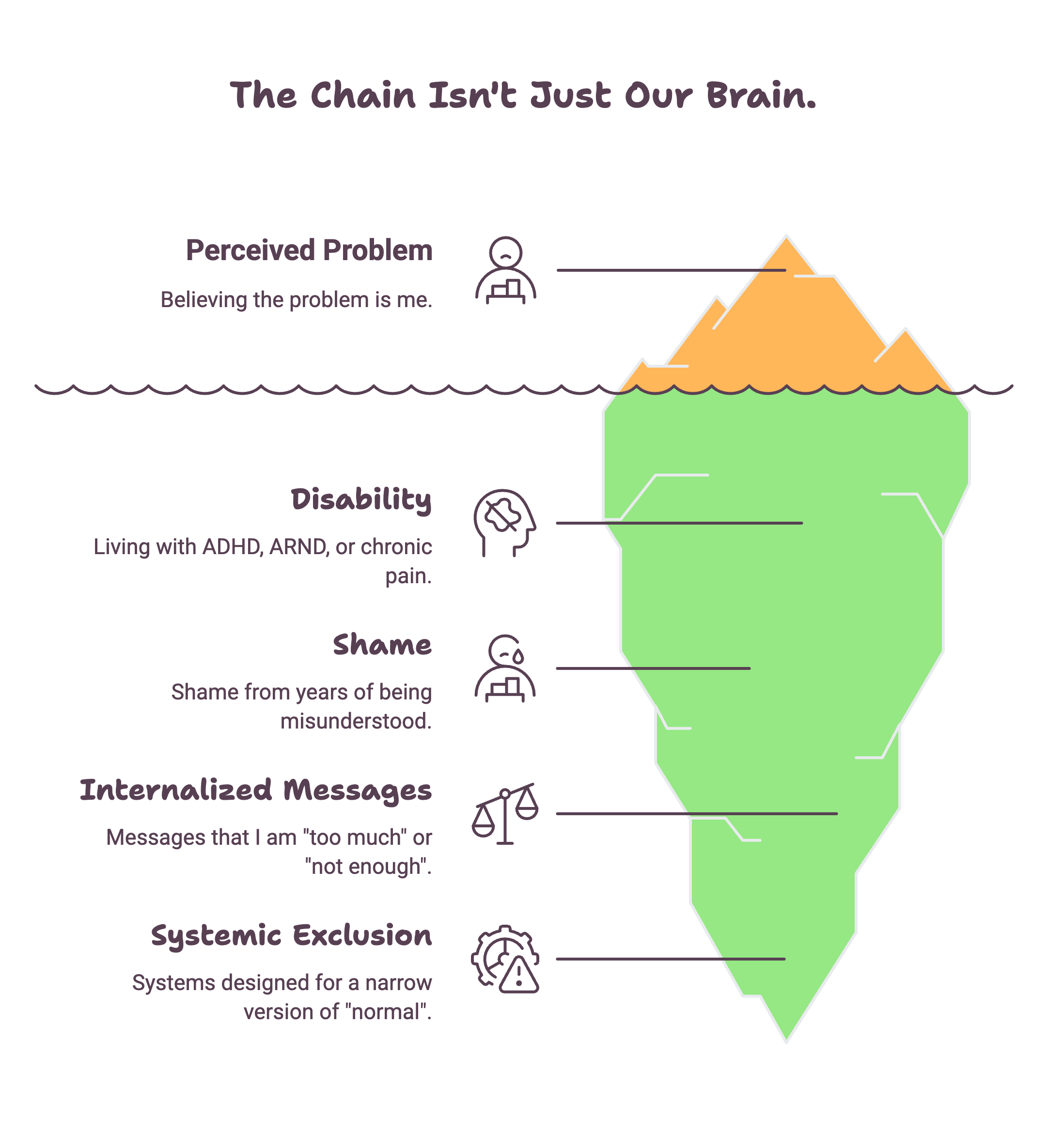
The Chain Isn’t Just Our Brain
For years, I believed the problem was me. If I could just focus harder, be more disciplined, and push past the fatigue, I could finally become who I was “supposed” to be. The narrative was simple: fix your brain, fix your life.
But that story was never the whole truth.
The “chain on my brain” is not just living with ADHD, ARND, or another disability, or living with chronic pain or long-term medical conditions.
It is also:
Shame from years of being misunderstood
Internalized messages that I am “too much” or “not enough”
Systems and expectations designed for a narrow version of “normal” that exclude many people living with disabilities
Our disabilities are real. Our bodies and brains are real. But the chain is built just as much from the stories we’ve been told about what those disabilities mean.
A Life That Refuses to Be Reduced
I am 54 years old. I’ve lived half my life with chronic illness. I’ve been married for 32 years. I have five children and three grandchildren.
If you only looked at the fact that I am living with disabilities, or at my medical chart and diagnostic labels, you would miss the most important part of my story.
My life is not a “despite” story. It’s not: “You’ve done all this despite living with a disability.”
It’s a because story:
Because my brain works differently, I’ve learned to be creative in how I show up.
Because I'm living with chronic illness, I’ve learned resilience, pacing, and compassion.
Because of my lived experience of disability, I can stand alongside others who feel like they don't fit anywhere.
These are not small things. They are the foundation of a meaningful life.
Cutting the Lock (Without Erasing the Past)
So what does it mean to “cut the lock” on the chain?
It does not mean:
Pretending that living with a disability or chronic illness isn’t real
Pushing ourselves into burnout to prove our worth
Forcing our bodies and brains into molds that harm us
Cutting the lock means we stop letting our past and other people’s definitions decide what is possible.
It sounds like:
“My history is part of me, but it does not get to be my ceiling.”
“My brain may be wired differently, but that does not make my contributions less valuable.”
“I can honor the realities of living with a disability and still claim my potential.”
We carry our past with us, especially when it includes trauma, misdiagnosis, or years of being dismissed. But we do not have to carry it as proof of what we can’t be.
Embracing a Future That Honors Our Reality
The future we deserve is not built on denial. It’s built on honesty and self-compassion.
For many of us living with disabilities, embracing that future looks like:
Designing environments that work with our brains and bodies instead of against them
Allowing rest and pacing to be valid, non-negotiable parts of our lives
Letting go of timelines that were never designed with disabled people in mind
Measuring success in connection, contribution, and authenticity, not productivity alone
Potential doesn’t mean becoming “indistinguishable from peers.” It means becoming more ourselves, with support, accommodations, and community.
When I say, “I have a chain on my brain; let me go cut the lock,” I am not asking to be cured. I am asking to be free.
Free to:
Tell the truth about living with a disability
Refuse shame as a measure of my worth
Live a life where limitation and possibility coexist
You Are Not the Chain
If any of this resonates with you, please hear this clearly:
You are not your diagnosis.
You are not your worst day.
You are not the chain.
Your story is still being written, at whatever pace your brain and body allow. There is room in this world, and in this movement, for your way of being.
Common Questions About Living With Disability and Shame
Does living with a disability or chronic illness limit my potential?
No. A diagnosis describes how your brain or body works. What limits people more often is the shame stacked on top of it, not the diagnosis itself.
How do I stop shame from feeling like part of my diagnosis?
Start by separating the two out loud: the condition is real, but the shame was added later, usually by systems or people who didn't understand it. Naming that difference is often the first step toward “cutting the lock.”
What does “cutting the lock” mean if I can’t change my diagnosis?
It means refusing to let your past, or someone else’s definition of “normal,” decide what’s possible for your future. You keep the diagnosis and lose the shame attached to it.
At Embracing Neurodiversity, we believe in a future where dignity, acceptance, and belonging are not negotiable for people living with disabilities and neurodivergent people. If you're ready to explore what “cutting the lock” looks like in your life, take our free Start Here intervention tool, explore our books, or read our story.
You don't have to walk this path alone.