
Chapter 1:
How to Read This Book
Two dads. A whole lot of coffee. Cutting-edge neuroscience translated into kitchen table wisdom you can use today — in your home, with your child, without a certificate.
What's on This Page
You've Got Full Access — Welcome In
Every resource on this page — and throughout the entire parent guide — is yours, free. No paywalls, no subscriptions. Just log in with your reader account to unlock all chapter resources, intervention tools, and downloadable guides.
Already have an account? Log in here
A Different Kind of Parent Guide
Pages 15–18 of Embracing Hope
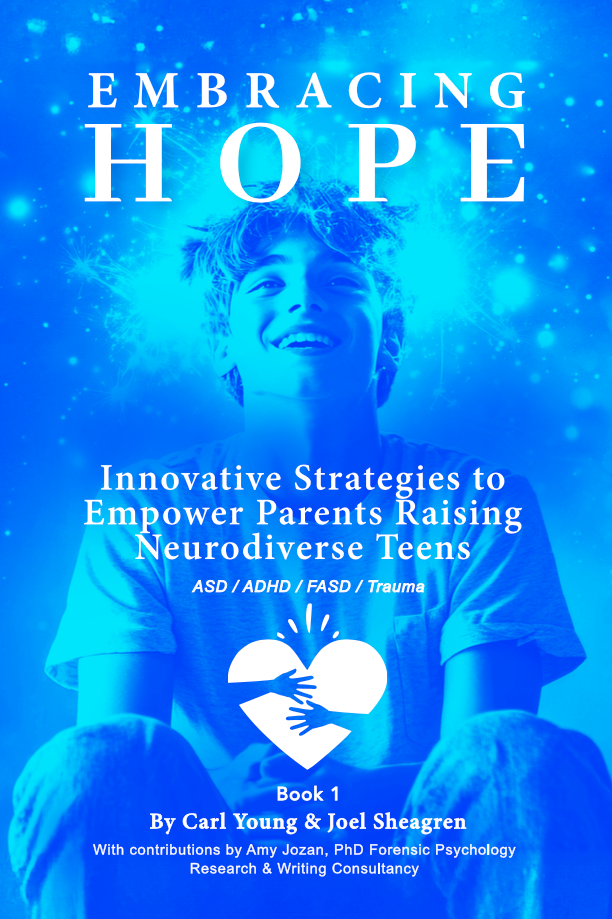
Picture this: two dads, a whole lot of coffee, and countless "interesting" parenting moments that would make reality TV look boring. We're not just authors writing another parenting book — we're fathers who live this journey every day, celebrating the beautiful chaos and unexpected joys of raising children with FASD, ASD, ADHD, and trauma-related challenges.
We've translated cutting-edge neuroscience into "kitchen table wisdom." Every strategy we share has been tested in real homes (including ours!), refined through practical application, adapted for our children's various neurodevelopmental profiles, and validated by leading researchers worldwide through evidence-based research.
Real Homes
Eight years ago, we were just like you — searching for answers, feeling overwhelmed, and wondering if we were doing the right things.
Real Research
Everything we share comes from years of intensive research, collaboration with leading experts, and — most importantly — learning from our children.
Real Strategies
These strategies work in real homes with real families — no sterile clinic settings or theoretical frameworks that fall apart at the kitchen table.
Why This Book Is Different — Three Pioneering Firsts
What makes this guide revolutionary isn't just that it breaks new ground — it's how these elements work together in one book.
First parent guide to explicitly recognize FASD as part of the neurodiversity spectrum — alongside ASD, ADHD, and trauma in one caregiver book.
First resource bridging the gap between professional expertise and lived experience — authored by two fathers who have walked this road.
First comprehensive approach treating these four profiles not as separate challenges but as interconnected, overlapping aspects of neurodiversity's uniqueness.
Your Child's Emotional World
Our neurodiverse children don't just feel emotions — they experience them in HD, 4K, and sometimes in IMAX®! While other children might get frustrated, our kids might feel like they're starring in their very own action movie. That's not a problem to be solved — it's an intensity to be channeled. Throughout this book, we show you how to turn these intense emotions into opportunities for growth and connection.
A Note About Privacy
While the stories you'll read are real (or based on real stories), we leverage fictional characters to protect the privacy of our children and families. After all, our kids are already superheroes — they don't need their secret identities revealed.
Whether you're a veteran parent, a grandparent stepping into a primary caregiver role, a foster or adoptive parent, or a professional — a teacher, social worker, therapist, or group home caregiver — you've found your tribe. Together, we're not just raising children — we're raising world-changers.
Chapter 1: Understanding the Core Conversations
Think of this book as your GPS for the parenting journey ahead — clear when you need directions, flexible when you need a detour, reliable when you feel lost, and always there when you need to recalibrate.
We've identified what we call the "Core Conversations" — outlined in chapters 5 to 19 — that shape the daily lives of neurodiverse families. Each one is a deep, research-backed exploration of a specific challenge neurodiverse teens face, paired with practical strategies you can start using today.
How to Read This Book
Each chapter is thoughtfully crafted to stand independently, allowing flexibility in how you read. While it can be read sequentially like a novel, it is inherently designed to be read selectively, based on your immediate needs.
Feel free to jump directly to specific Core Conversations for immediate strategies — dive deep into brain science when you're ready, focus on specific interventions that match your current needs, and return to earlier chapters as your journey evolves.
List of Core Conversations
Chapters 5–19 each explore one Core Conversation — a deep, research-backed look at a specific challenge neurodiverse teens face, paired with practical strategies you can use today.
The 10 Aspects Highlighted in Every Core Conversation Chapter
Each Core Conversation chapter (5–19) includes these ten consistent elements so you always know what to expect and where to find what you need:
Part A: Anecdotal story with one of the four fictional characters
A definition of the conversation topic being covered
Something Worth Noting — research highlights & statistics
Symptoms versus behaviors — understanding the difference
Suggested interventions — practical, home-based strategies
Part B: Story revisited using one intervention from the chapter
A personal story from Carl or Joel
A haiku — a moment to breathe and reflect
Brain Regions — the physical structures involved
Brain Domains — the functional systems at work
Meet the Four Fictional Guides
Throughout the book, four special fictional characters bring real-world scenarios to life — giving context to the overlapping challenges across all four neurodiversity profiles. Though each character represents one profile, the stories are intentionally written around the overlapping characteristics of all four.
Zak
Zak represents the lived experience of Fetal Alcohol Spectrum Disorder — a brain-based invisible disability that often looks like behavior but is always about the brain. Warm, funny, and full of love.
Q
Q shares the autism spectrum experience — a different way of processing the world, connecting with others, and making sense of social rules that others absorb without thinking.
Shay
Shay illustrates the ADHD experience — a powerful engine with a unique steering system. Creative, energetic, and deeply feeling, navigating a world built for a different kind of brain.
Kennedy
Kennedy highlights the experience of trauma — a nervous system shaped by loss, fear, and survival. Resilient, intuitive, and deeply human, finding a path toward healing.
Jodee Kulp created three of the four fictional characters woven throughout the Embraced Movement — including Zak, whose story is also told in the companion novel Embracing Zak, available on Amazon.
Full Intervention Chart
Every intervention from the Core Conversation chapters (5–19), listed alphabetically. Hover any intervention name for a full description. Use the chapter filter to find strategies for a specific topic.
Hover any intervention name in the left column for a full description and the chapters where it appears.
Full Intervention Chart
Every intervention featured in the Core Conversation chapters (5–20), listed alphabetically. Use the filter to focus on a specific chapter, or view all. Verify against the printed book (p. 489) for the authoritative reference.
| Intervention | Chapter | |||||||||||||||
|---|---|---|---|---|---|---|---|---|---|---|---|---|---|---|---|---|
| 5 | 6 | 7 | 8 | 9 | 10 | 11 | 12 | 13 | 14 | 15 | 16 | 17 | 18 | 19 | 20 | |
Source: Embracing Hope
Why We Don't Use Traditional CBT — And What We Use Instead
Traditional Cognitive Behavioral Therapy is well-established and evidence-based for neurotypical populations. But it consistently falls short for children with FASD, ASD, ADHD, or trauma histories when applied in its standard form — not because CBT is wrong, but because neurodiverse brains work differently. Here's what we've learned.
Why Standard CBT Often Doesn't Work
- Requires abstract thinking — which many neurodiverse children experience inconsistently
- Depends on consistent memory recall — challenging for FASD, ADHD, and trauma-impacted brains
- Relies on linear self-reflection — a process that can feel inaccessible under stress
- Assumes language-based insight — many neurodiverse children process emotionally, not verbally
- Needs the child to hold concepts across sessions — working memory limitations interfere
- Most therapists lack the specialized neurodiversity training needed to adapt it properly
- Modified so much for neurodiverse use, it should no longer be called CBT
Metacognitive & Executive Function–Informed Interventions
- Starts with how neurodiverse brains actually function — not how we wish they would
- Teaches thinking about thinking — making internal processes visible and concrete
- Designed for home use — no certificates required, just an open heart and mind
- Uses visual, narrative, and movement-based pathways to bypass language barriers
- Builds neuropathways through repetition, relationship, and safe practice
- Meets the child in the present moment rather than relying on future recall
- Paired with Theory of Mind strategies to help children understand different perspectives
A Closer Look: CBT vs. Metacognition Across Four Dimensions
Here's how the two approaches differ in practice — and why the distinction matters for your child:
Think. See. Change. (TSC) — Visual Metacognition
We've renamed this evidence-based strategy for ease of remembrance. Think. See. Change. is our name for Visual Metacognition — a variation of the metacognitive approach that helps children and teens visualize their thoughts, creating greater self-awareness and self-regulation, and guiding actionable steps for positive transformation.
TSC helps us shift from being inside a thought (where it controls us) to being outside a thought (where we can observe and choose). This is the core of reshaping neuropathways — not through willpower alone, but through guided visual awareness practiced over time.

Think
Notice the thought that's happening. Don't react to it yet — just observe that it's there. "I'm having a thought right now."

See
Visualize the thought — draw it, write it, map it, or imagine placing it outside yourself. Make the invisible visible.
Change
From outside the thought, choose a response. Redirect, challenge, accept, or act. The choice belongs to your child.
TSC bypasses the language-processing bottleneck by using visual and spatial channels. It reduces the demand on working memory by externalizing the thought. And it builds neuropathways through consistent, low-pressure repetition in safe moments — making the strategy available when the emotional stakes are higher.
Your Toolkit for Success
The book packs an extraordinary amount of practical tools — the majority of which you can implement at home without professional training.
Evidence-based intervention strategies across all Core Conversation chapters
Additional tips woven throughout the chapters (marked with the book's logo icon)
Academic citations available for deeper exploration of the research
Codes at the end of each chapter linking to additional online resources
How the Intervention Symbols Work
Throughout the book and in the Intervention Chart below, symbols help you understand how each strategy can be used:
More Than Just a Book — The Embraced Movement
Embracing Hope is part of something bigger. Alongside this book, the Embraced team is creating a full ecosystem of resources to support neurodiverse families worldwide.
Embracing Zak — The Novel
Written by Jodee Kulp, this novel brings real neurodiverse experiences (FASD, ASD, ADHD) to life through Zak and his cast of friends — a high school senior who brings an entire community together.
Available on Amazon →
Feature Film (Fundraising)
A screenplay by Justen Overlander based on Jodee's novel, designed to spread understanding and acceptance of neurodiversity to a wider audience.
embracingzak.com →
Embraced Documentary — FASD
"Embraced: Truth About Fetal Alcohol Spectrum Disorders" — a groundbreaking docudrama mixing interviews with a narrative of Zak from birth to high school.
embracedmovement.org →
Online Courses
Parent training related to the Core Conversations in this book, plus professional programs to help educators and social workers better support neurodiverse children.
Explore Courses →
Embracing Heroes App
A technology platform currently in development, specifically designed to help neurodiverse children achieve better life outcomes through personalized digital support.
In Development
Online Community
A parent community where families like yours can connect, share experiences, and support each other. Find the Discord link on our website.
Join the Community →A Note on Language — Looking Ahead
Throughout this book, we intentionally use terms such as profile, trait(s), differences, strengths and challenges, characteristics, variations, wiring, abilities, and perspectives to describe neurodiversity. This reflects our commitment to reducing stigma and promoting a more inclusive, strengths-based understanding.
We also intentionally use "your teen," "our children," and occasionally "our kiddos" instead of the academic term "individuals" — because after all, this is personal.
A Note on "Our Research"
When we refer to "our research," we are referencing insights gained from reviewing existing clinical studies conducted by other researchers — not original studies we personally carried out. There are over 900 citations throughout this book that can be explored to further your education.
"The greatest gift we can give our kiddos is not perfection, but permission — to be seen, to be different, and to be deeply loved."— Carl & Joel