
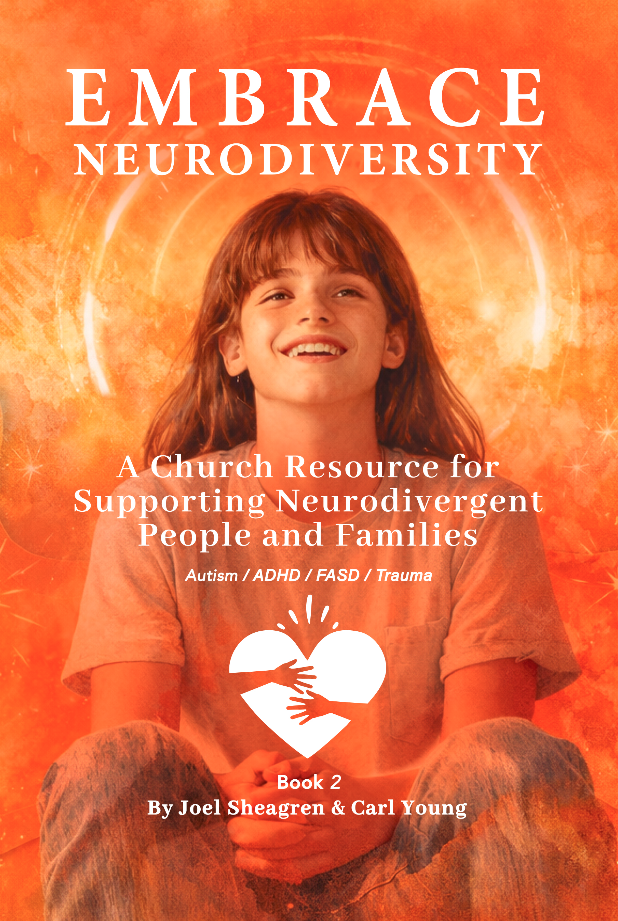
Embrace Neurodiversity
Book Introduction
A shepherd's field manual for pastors, leaders, and congregations ready to welcome and embrace neurodivergent children, youth, and families.
Your Church Is Already Full of Neurodivergent Families
In pews and classrooms, in fellowship halls and youth retreats, there is a quiet, growing crowd whose needs often go unseen. They are fidgeting instead of focusing, melting down instead of worshiping, wandering instead of engaging — or sitting silently in emotional lockdown.
These families often sit in the back row or sneak out early. Their parents carry invisible weights. They may feel like misfits in the body of Christ when, in fact, they are vital members of it.
"He tends his flock like a shepherd: He gathers the lambs in his arms and carries them close to his heart."
— Isaiah 40:11This guide is for them. And for you. It is a shepherd's tool, designed not to overwhelm but to equip you with vision, compassion, and strategy. You don't need to become a clinician — you need to love differently. Jesus never asked anyone for a label before extending connection, healing, presence, or welcome.
This supplemental resource library goes deeper than the book — with extended guides, practical tools, theological grounding, and ministry frameworks organized section by section.
Awaken your imagination
See behaviors as communication, not rebellion. Shift from "What's wrong?" to "What support is needed?"
Equip with understanding
A working knowledge of ASD, ADHD, FASD, and trauma — no degree required.
Practical biblical strategies
From worship adaptations to pastoral care — faith applied to real ministry situations.
Reimagine church culture
Move from accommodation to celebration — where differences are design, not disruption.
"This book calls the church not just to include, but to embrace those who experience and express life differently. It's not a manual, it's a movement. A Kingdom vision where every mind, every heart, every child belongs."
— Pastor Steve Fitzhugh, Speaker, Coach & ChaplainYour Guides Through the Journey
Four fictional teenagers — based on real stories — appear throughout every chapter to make neurodiversity personal, vivid, and actionable for ministry leaders.
Q
A bright, introspective teen boy on the Autism Spectrum. He thinks deeply, feels intensely, and is often misread by those who don't slow down enough to understand him.
Shay
An energetic, impulsive teen girl navigating life with ADHD. Her overflow of energy and creativity is a gift — when leaders know how to make room for it.
Zak
A funny, resilient teen boy affected by Fetal Alcohol Spectrum Disorders. His humor and heart are undeniable — once leaders learn to see what's underneath his behavior.
Kennedy
A quiet, guarded teen girl whose history of trauma shapes every interaction. The church can become the safe place her nervous system has been searching for.
All 5 Chapters
Every section is designed to move from understanding to practice — and from practice to culture change in your church community.
Understanding Neurodevelopmental Differences
An overview of ASD, ADHD, FASD, and trauma-impacted development — with a focus on overlapping symptoms, shared challenges, and how to shift from "what is wrong?" to "what is needed?"
- How ASD, ADHD, FASD, and trauma overlap in real ministry settings
- The Quick Lens: Behavior = Communication framework
- Why these are brain differences, not defiance or spiritual failure
- Statistics: how prevalent these profiles really are in your congregation
- Meet Q — and what it costs when we misread his experience
Creating Environments for the Neurodivergent
Practical strategies for adapting physical spaces, worship rhythms, and communication so that your building and culture genuinely welcome — not just tolerate — neurodivergent members.
- Sensory-friendly sanctuary and classroom adjustments
- Worship adaptations that lower barriers without lowering engagement
- Communication tools: visual schedules, clear language, predictability
- Shay's story — what happens when energy has no healthy outlet
- Simple, low-cost changes that make outsized differences
Ministry-Specific Applications
Guidance for children's ministry, youth ministry, adult discipleship, and family support — showing how inclusion takes shape in real-life ministry contexts, from Sunday school to youth retreats to small groups.
- Children's ministry: sensory kits, quiet corners, transition support
- Youth ministry: what Zak needs to receive communion safely and meaningfully
- Small groups: adjustments for ADHD time-blindness and focus challenges
- Family support ministry: being a church families can actually stay in
- Inclusion as Gospel — not a "special ministry" sidebar
Pastoral Care for Neurodivergent Individuals & Families
Resources for spiritual formation, crisis response, grief support, and building long-term relationships that strengthen families and individuals — including tools for when things go hard, fast.
- Crisis support framework (pp. 99–101) — what to do in the moment
- Trauma-informed care: meeting Kennedy with gentleness after worship
- Spiritual formation for neurodiverse learners — faith development that works
- Long-term relationship rhythms with neurodiverse families
- Grief support for parents navigating diagnosis and loss of expectations
Building a Church Culture of Celebration
A vision for leadership training, theology of inclusion, and community advocacy to help churches build a culture where neurodiverse identity is affirmed as a core Kingdom value — not a program add-on.
- Leadership training: equipping volunteers and staff to see differently
- Theology of inclusion — what Scripture says about disability and design
- Moving from accommodation to celebration in your congregation
- Community advocacy: the church's role beyond Sunday
- How to champion neurodiversity as a Kingdom mission, not a mercy project
These Families Are Already in Your Church
Whether recognized or not, neurodevelopmental differences show up in every gathering. Leaders often feel unprepared — not from lack of compassion, but from lack of context. This resource changes that.
Additional Resources
Conclusion: Called to Draw the Circle Wider
The conclusion calls every church leader not to add a new program, but to infuse their existing ministries with greater awareness, empathy, and adaptability — beginning a kingdom movement of belonging. Pages 137–140.
Read Conclusion →About the Authors: Joel & Carl
Two dads from different states who found each other at a conference in 2017 and refused to let neurodiverse families fight alone. Their story is the mission's foundation.
Learn More →The Embraced Movement
This book is one part of a larger movement including novels, a feature film (in development), courses, an advocacy app, and a caregiver resource — all rooted in hope for every family.
Explore →